

Head, Heart, and Hands
Employee engagement is becoming the leadership challenge for the early 21st Century. In a world pressured by constant change, agility, and digital transformation, how leaders connect, communicate and inspire their people in organisations will matter more than how work is done. Last month, we attended a panel discussing revolutionising leadership - the power of inclusivity. The leadership trinity of Head, Heart, and Hands methodology is effective and valuable to leaders and organisations today. It is a holistic and human-centric approach that incorporates the what (head), why (heart), and how (hands) into leadership practices.
Head represents the concern for vision, direction, and guidance. How do we create our vision for the future and identify the priorities to get there? Leaders need to reflect on the organisation's purpose and values. Reflection can lead to awareness which is necessary for change. Without it, organisations cannot identify, question, and reframe underlying values and beliefs, acknowledge and challenge assumptions, recognise bias, identify fears, and understand strengths and weaknesses. Making time for reflection is something we often advise clients, and strive to implement for ourselves. This inward retrospection is part of an identity formation for the business and underlies the values and beliefs that support the views and strategies they develop.
Heart represents the concern for inspiration and energy. How do we inspire and empower people? Heart encourages emotional intelligence leadership by embedding purpose to an organisation’s “why” and its existence. It is more important than ever in the always-on era. When people understand the benefits of the "why", they are more likely to be motivated to execute that goal together. Leaders should drive a culture that emphasises people and the team as this will ultimately nurture relationships. Relationships have a powerful effect on people’s emotions, thoughts, and behaviours because human beings have a fundamental need to belong. It is team relationships that transform pointless tasks into directed, meaningful experiences. It even fuels transformation by fostering an emotional connection that inspires greater commitment and the willingness to go the extra mile.
Hands represent the concern for achieving goals. How do we execute amid constant change? It is the habits, actions, and tools for execution. It deals with holding people accountable and ensuring that they perform and that processes are iteratively developed. Leaders need to show support and provide feedback. It is especially important to provide feedback to employees as they take steps towards learning or engaging with new procedures and tools.
When the Head and the Heart are aligned, leadership becomes effective. The deep cultural level, where the Head and the Heart exist is the basis of how people work. It includes values (company and individual), norms (acceptable and unacceptable behaviours), identity (connections), as well as relationships and attitudes. Apply the Hands element of leadership into the mix and you end up with a fully engaged and transformative team.
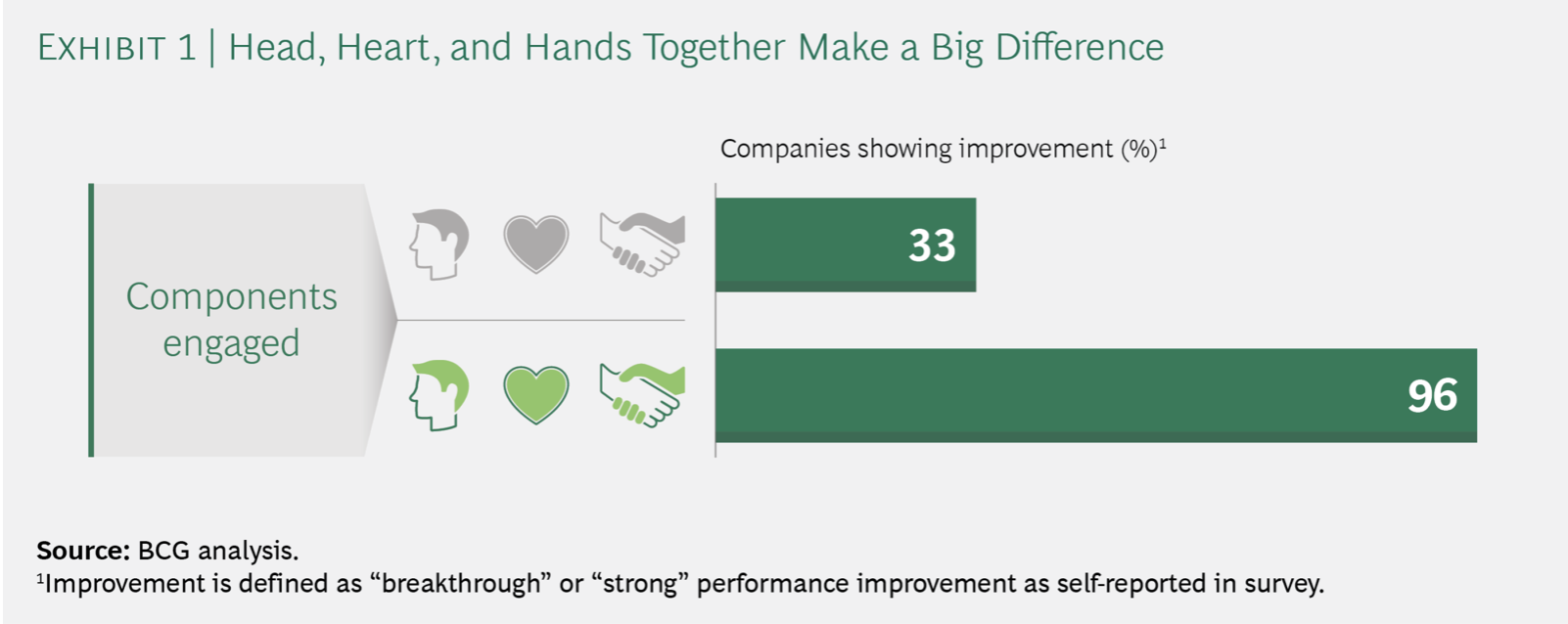
A study conducted by BCG suggests that the Head, Heart, and Hands leadership methodology is most powerful when all three elements are fully engaged in parallel and seen as a holistic approach. BCG saw 96% of the companies that fully engaged the three elements achieved sustained performance improvement, a rate nearly three times that of companies that did not engage the elements.
The Head, Heart, and Hands methodology is a revolutionising approach to leadership that increases employee engagement, fosters a healthy and empowering culture, and is critical to organisational transformation. Most leaders are not all head, heart, or hands – most are a combination. However, if we strive to balance this trinity of leadership elements holistically, teams, leaders, and organisations will all benefit from the increased level of engagement, persistence, and accomplishments.